






- 04 Feb, 2026
- Software Development
- Outsourcing
- By Musketeers Tech
Nearshore Software Development: The Complete Guide (2026)
Nearshore software development is one of the fastest ways to scale engineering capacity without accepting the communication gaps that often come with far-off outsourcing. If you’re a founder, product manager, or operations leader trying to ship faster, keep quality high, and still control costs, nearshoring can be the “middle path” between expensive onshore hiring and hard-to-manage offshore delivery.
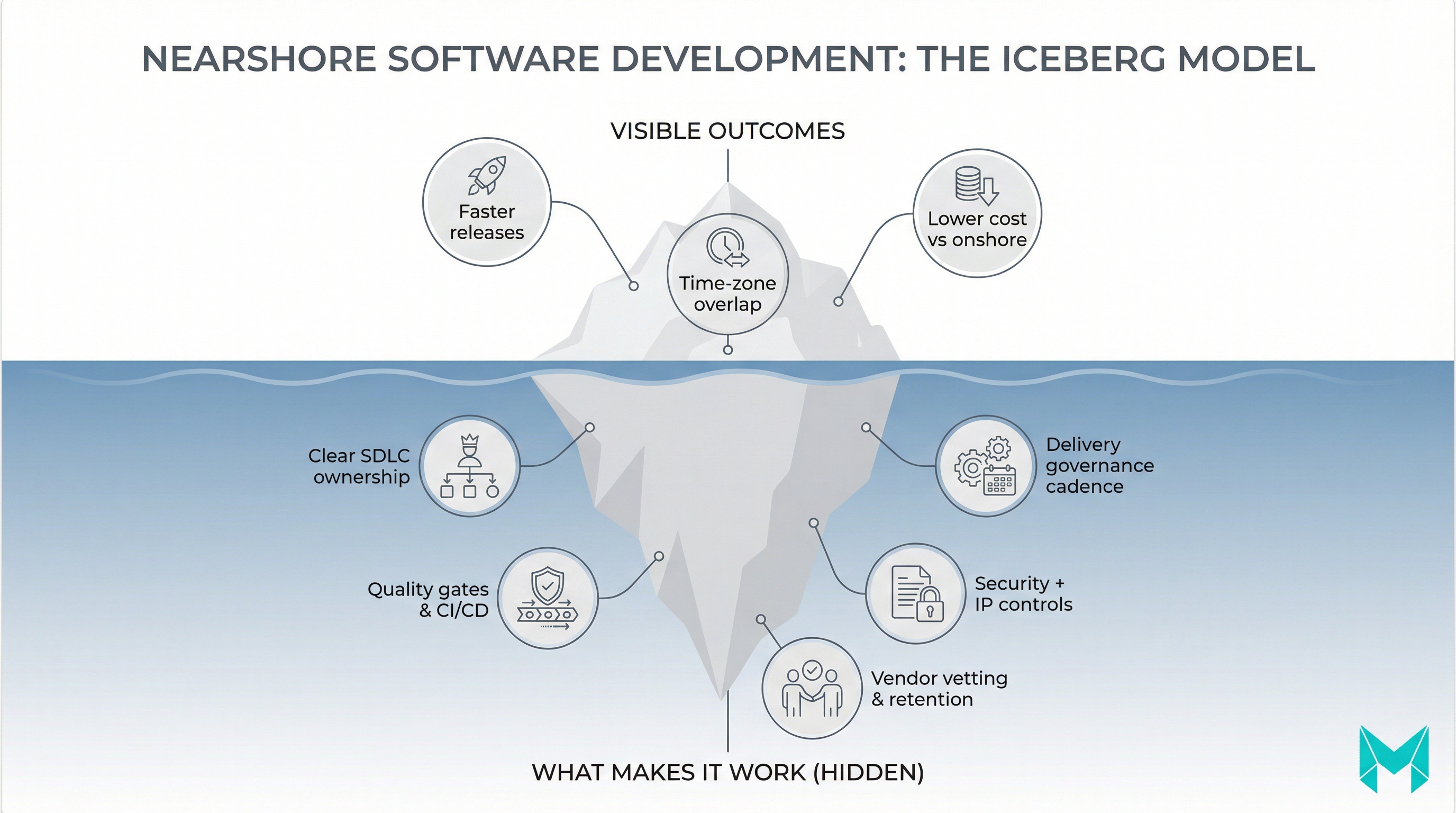
But the model only works when you treat it like a system not a staffing transaction. The best results come from choosing the right engagement model (staff augmentation vs dedicated teams vs project delivery), setting clear SDLC ownership, and running tight governance (cadence, KPIs, quality gates, and security/IP controls).
This guide breaks down what nearshore software development is, how it compares to offshore and onshore, typical costs, where LATAM teams (including Mexico) shine, and a 2026-ready scorecard you can use to evaluate vendors and run delivery with confidence.
What is nearshore software development? (software development nearshore)
Nearshore software development means working with a development team in a nearby country, typically with strong time-zone overlap and easier real-time collaboration than offshore arrangements. For US companies, “nearshore” most commonly means Latin America (LATAM)—Mexico, Colombia, Costa Rica, Brazil, Peru, Uruguay, and more—because teams can overlap with North American working hours.
In practice, nearshoring can look like:
- Adding engineers to your existing team (staff augmentation)
- Hiring a complete, managed product squad (dedicated agile team)
- Outsourcing an outcome (project-based delivery with milestones)
The business reason to nearshore is simple: you’re optimizing for a blend of speed + cost + collaboration. Unlike pure offshore, nearshore teams can participate in the same standups, respond during the same workday, and iterate quickly—especially important for Agile product development.
If you’re evaluating alternatives, it’s worth reading our broader outsourcing primer: offshore software development overview.
Nearshore vs offshore vs onshore: what’s the difference?
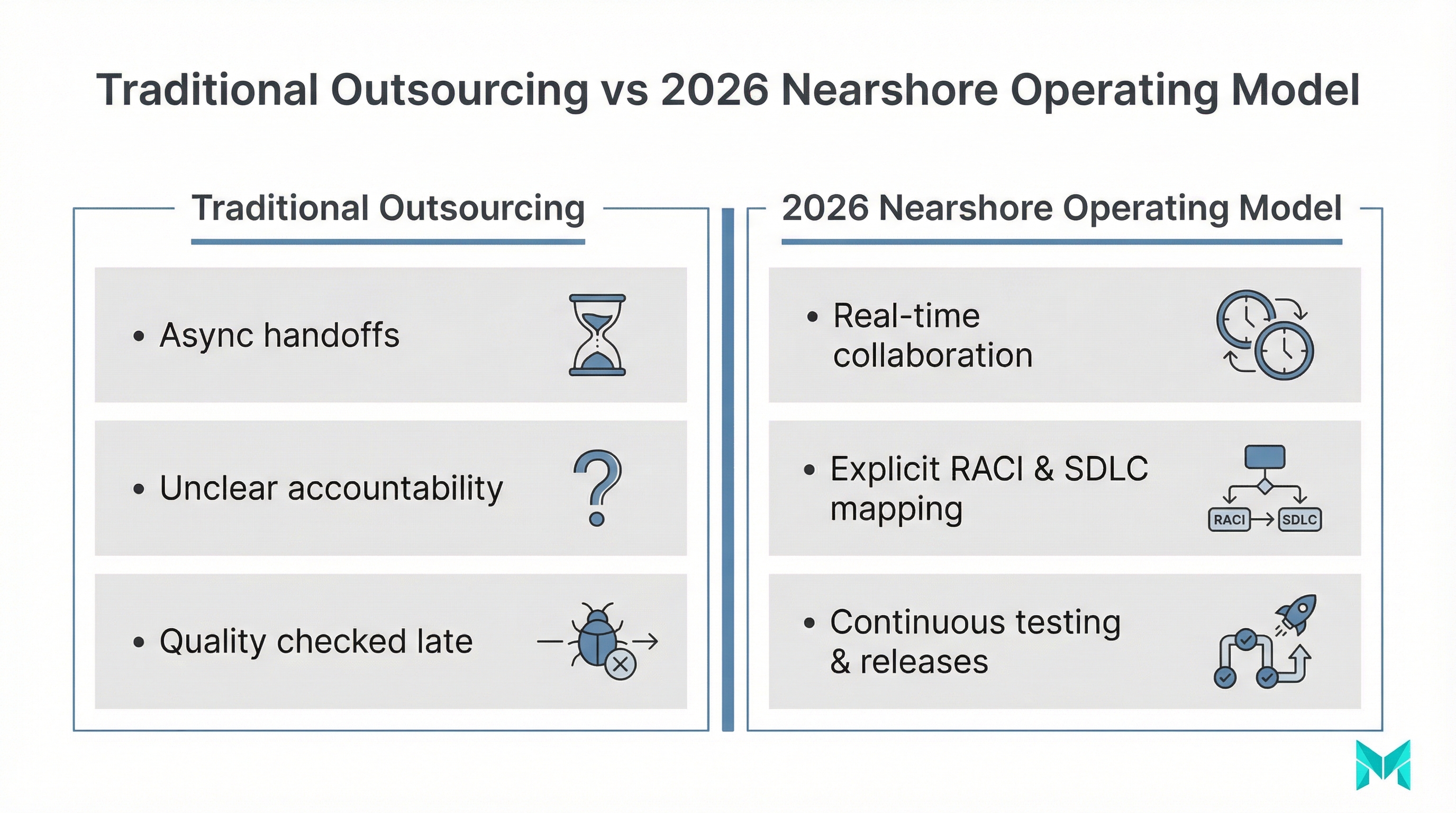
Here’s the decision lens most teams miss: the main difference isn’t just hourly rate—it’s feedback latency (how long it takes to clarify requirements, unblock issues, and ship iterations).
Quick comparison
| Model | Where the team is | Collaboration | Typical tradeoffs |
|---|---|---|---|
| Onshore | Same country | Easiest real-time work, often onsite | Highest cost; limited local talent supply |
| Nearshore | Nearby countries / similar time zones | Real-time overlap, easier travel | Slightly higher rates than some offshore regions; still requires strong governance |
| Offshore | Distant regions (large time difference) | Often async; slower loops | Cheaper on paper; higher coordination risk and rework if discovery is weak |
Rule of Thumb
If your product requires fast iteration (SaaS, mobile, marketplace, AI features), nearshoring usually beats offshoring because you avoid the “one-day delay” cycle.
Why nearshore software development is becoming more popular
- Talent scarcity in local markets: Senior engineers are hard to hire domestically without paying top-of-market premiums.
- Remote delivery is now normal: Modern tooling and culture enable distributed delivery—time-zone overlap makes it seamless.
- Speed-to-market pressure: Nearshore overlap reduces delays in decisions, QA cycles, and incident response.
A helpful industry lens: Deloitte has discussed nearshoring as an offshore alternative in the context of supply chain and operational resilience (see: https://www2.deloitte.com/us/en/pages/consulting/articles/nearshoring-as-offshore-alternative.html).
The key takeaway: nearshore works best when your organization values shipping predictably more than simply minimizing hourly cost.
Nearshore software development services: engagement models that work
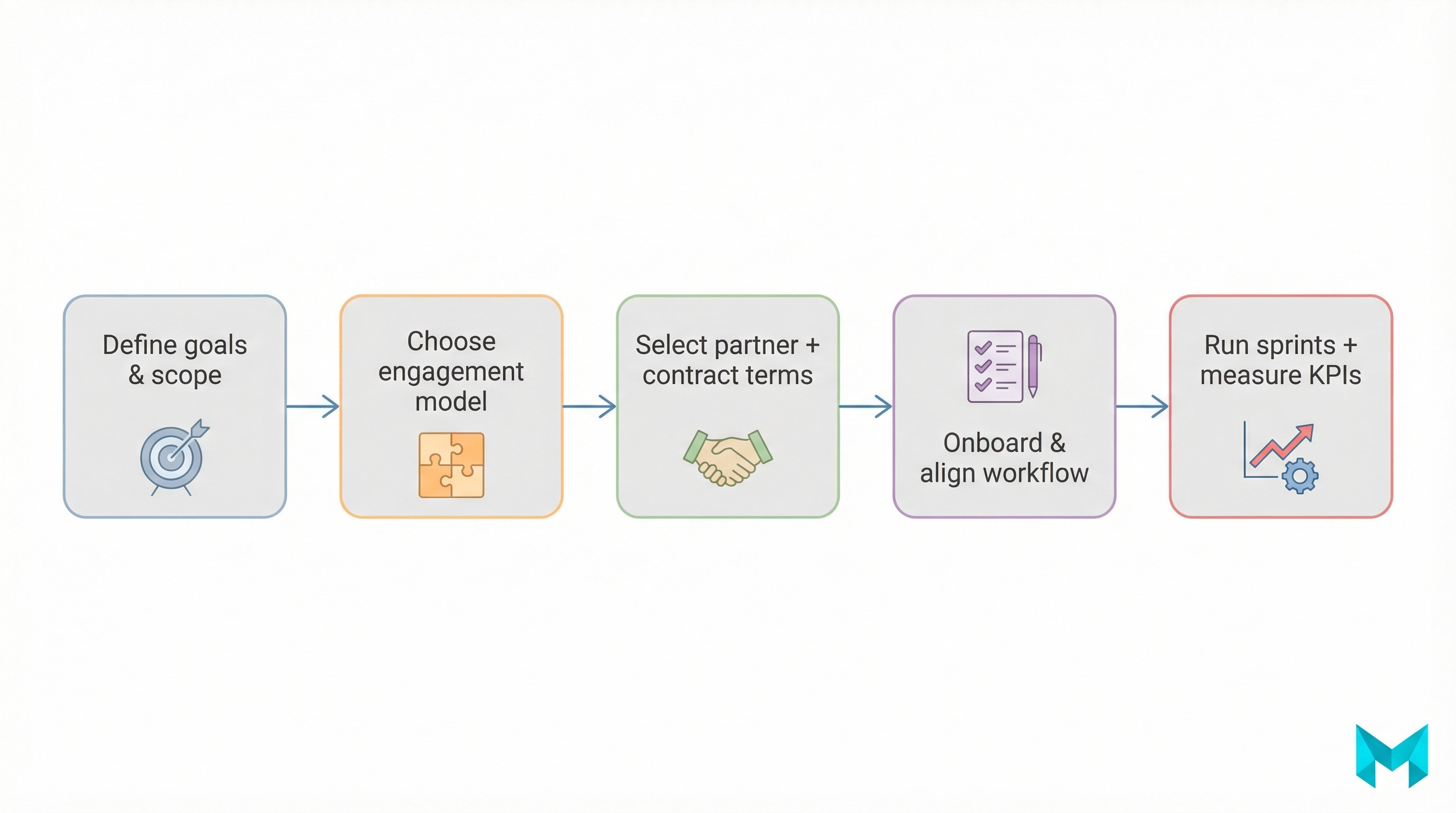
Most nearshore software development services fall into one of these models. Choosing the right one is as important as choosing the vendor.
Staff augmentation (flexible capacity)
You keep product ownership and delivery management, and the partner provides vetted engineers to fill gaps (frontend, backend, QA, DevOps).
Best when:
- You already have a strong tech lead/CTO
- You need to scale a specific function (e.g., QA automation)
- You want maximum control over priorities and architecture
Common pitfall: treating augmented engineers like “ticket takers” without context. You’ll get better outcomes if you onboard them into your product goals and quality standards.
Dedicated agile teams (nearshore agile software development)
A dedicated team is usually a cross-functional squad (PM/BA, engineers, QA, sometimes design) that ships continuously using Agile rituals and shared tooling.
Best when:
- You want faster throughput with less management burden
- You’re building a new product or major module
- You want consistent velocity and planning cadence
This model is where nearshore time-zone overlap becomes a competitive advantage—standups, sprint planning, and pairing sessions can all happen in real time.
Project-based delivery (outcome-focused)
You outsource a defined scope or milestone plan (e.g., MVP in 8–12 weeks, replatforming, integrations). The vendor manages more of the day-to-day execution.
Best when:
- You need speed and don’t want to staff internally
- Requirements are stable enough to define acceptance criteria
- You want a clearer budget envelope
Common pitfall: unclear acceptance criteria. If success isn’t measurable, you’ll pay for rework.
Nearshore software development in Mexico and LATAM: where to hire (latam developers)
LATAM is a popular nearshore region for US companies because it offers:
- Working-hour overlap across multiple time zones
- Large developer communities in major tech hubs
- Shorter travel time for quarterly planning or workshops
Mexico (a frequent first choice)
Nearshore software development in Mexico is often attractive due to proximity, travel convenience, and time-zone alignment with US Central and Mountain time. It can be a strong fit for:
- Customer-facing SaaS teams that need frequent product/CS feedback
- Regulated workflows that benefit from tighter coordination
- Teams that want occasional in-person workshops without complex logistics
Other strong LATAM options
While the “best country” depends on role availability and domain expertise, companies often build teams across multiple countries to diversify hiring and improve resilience.
If your priority is real-time collaboration, focus less on “country ranking” and more on:
- English proficiency + communication quality
- Seniority distribution (mid/senior ratio)
- Retention strategy (turnover kills velocity)
- Security and IP controls
Costs & rates: what nearshore usually costs (and what affects pricing)
Nearshore pricing varies by role seniority, tech stack scarcity, and engagement model (augmented engineer vs fully managed team). HatchWorks publishes a comparative table of onshore vs nearshore vs offshore ranges by role (architect, QA, DevOps, etc.), which is useful as a directional benchmark: https://hatchworks.com/blog/nearshore-development/nearshore-software-development-guide/
What drives nearshore cost in real life
- Seniority mix: a senior-heavy team costs more, but may ship faster with less rework.
- Team composition: adding QA automation and DevOps often increases cost but reduces defects and downtime.
- Process maturity: a mature vendor costs more than “cheap staff,” but governance reduces risk.
- Overlap expectations: full-day overlap can command higher rates than partial overlap.
Cost Optimization Tip
Optimize for cost per shipped outcome, not the lowest hourly rate. Cheap rates with high rework and slow feedback loops cost more overall.
Cost “sanity check” questions to ask vendors
- What’s included: PM, QA, DevOps, design, discovery?
- How do you handle replacements and ramp-down?
- What is your retention rate by country/role?
- Do you price by hourly, monthly per person, or outcome?
If you want a delivery-first mindset, don’t optimize for the cheapest rate—optimize for cost per shipped outcome.
The Nearshore Delivery Scorecard (2026): governance, KPIs, and SDLC ownership
This is the part most nearshore guides skip: how to run the engagement so it doesn’t drift.
Use this scorecard to evaluate a nearshore software development company and to set your operating model in week one.
1) Who owns what across the 7 stages of software development?
A practical SDLC breakdown (often taught as 7 stages) looks like this:
- Planning & feasibility
- Requirements & analysis
- Design
- Development (implementation)
- Testing (verification)
- Deployment (release)
- Maintenance & iteration
Nearshore works best when you define ownership explicitly:
- You (client) should own: product vision, priorities, success metrics, domain decisions, stakeholder alignment.
- Vendor should own: engineering execution, code quality, delivery process, documentation standards, and proactive risk reporting.
- Shared ownership: architecture decisions, security model, acceptance criteria, release readiness.
If you want an Agile framing for this, see our guide: what Agile software development means in practice.
2) Delivery governance: cadences that prevent surprises
Minimum viable governance for nearshore teams:
- Daily: standup + blocker escalation path
- Weekly: demo (show working software) + KPI review
- Biweekly: sprint planning + retro (process improvements)
- Monthly: roadmap review + risk register + budget vs burn
A good vendor will bring this structure proactively. A great vendor will tailor it to your constraints (security reviews, release windows, compliance).
3) Quality gates (so speed doesn’t destroy reliability)
Ask for—and enforce—these gates:
- Definition of Done (DoD) includes tests + docs + monitoring hooks
- PR reviews required (no direct-to-main)
- Automated testing baseline (unit + smoke + critical paths)
- Release checklist + rollback plan
- Bug SLAs (severity-based response times)
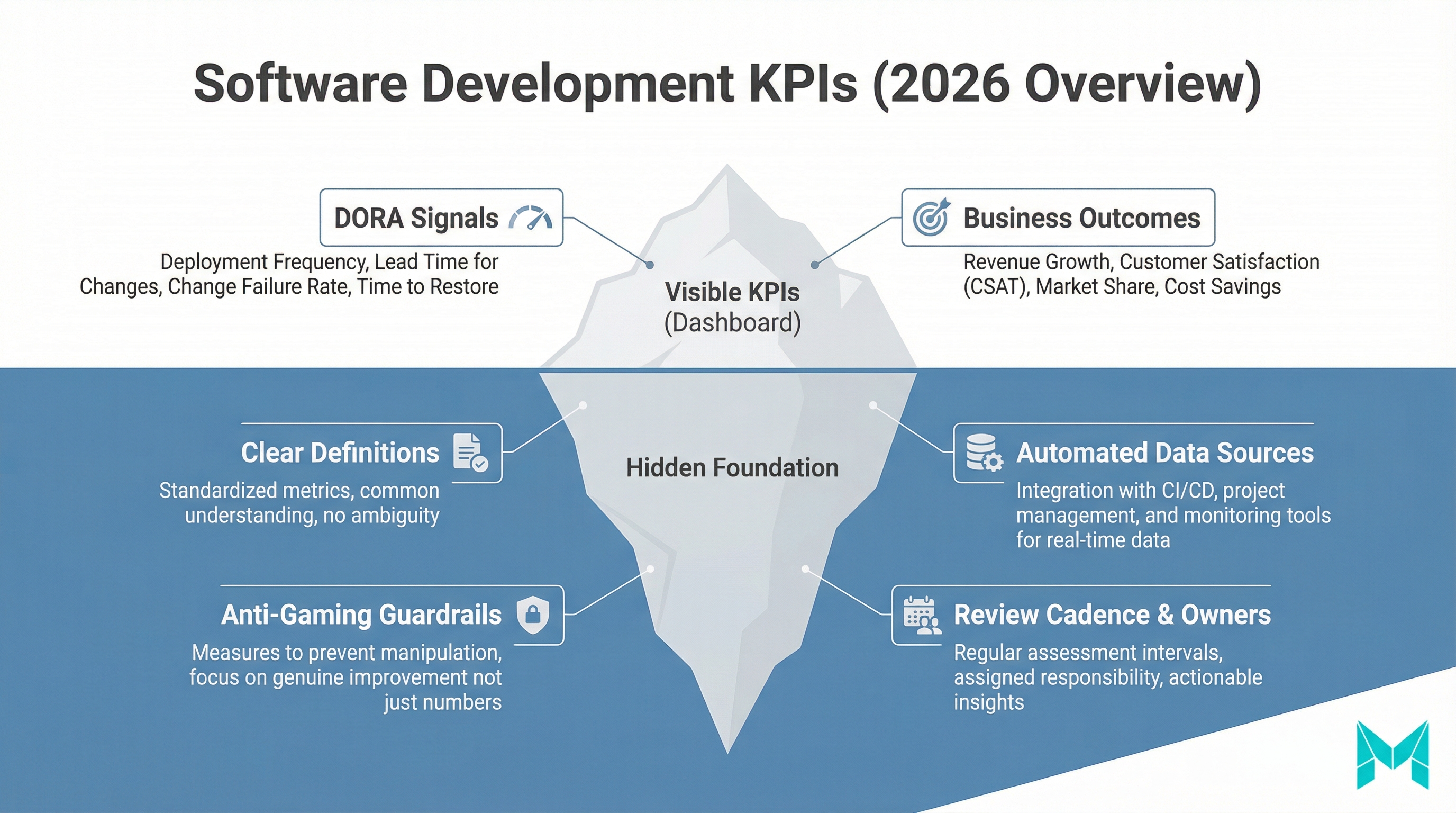
Track progress with a small set of metrics. If you need a KPI starter list, use: KPIs for software development teams.
4) Security + IP checklist (often overlooked)
- Signed IP assignment + confidentiality terms
- Access control: least privilege, SSO, MFA
- Secure SDLC: dependency scanning, secret scanning, SAST
- Data handling rules (PII, customer exports, logs)
- Incident response expectations + notification timelines
N-iX explicitly discusses “security by design” and compliance frameworks in their nearshore positioning, which reflects a broader market expectation for mature vendors.
Tools & platforms for nearshore collaboration
Nearshore teams perform best when tooling is standardized and visible.
Core stack (common defaults):
- Project management: Jira / Linear
- Docs & decisions: Notion / Confluence + ADRs (architecture decision records)
- Communication: Slack + scheduled Zoom/Meet
- Code: GitHub/GitLab with protected branches
- CI/CD: GitHub Actions/GitLab CI + automated deployments
- Observability: Sentry, Datadog, OpenTelemetry + dashboards
3 image filename suggestions (SEO-friendly) + prompts (Nano Banana)
- nearshore-software-development-hero.png
- Alt: “Nearshore software development connecting US and LATAM teams”
- Prompt: “Map-based illustration showing US connected to Mexico, Colombia, Brazil with timezone and collaboration icons; modern SaaS style”
- nearshore-engagement-models.png
- Alt: “Nearshore software development services models: staff augmentation vs dedicated teams vs project delivery”
- Prompt: “Minimalist 3-column infographic with icons and short bullets for engagement models; white background, high readability”
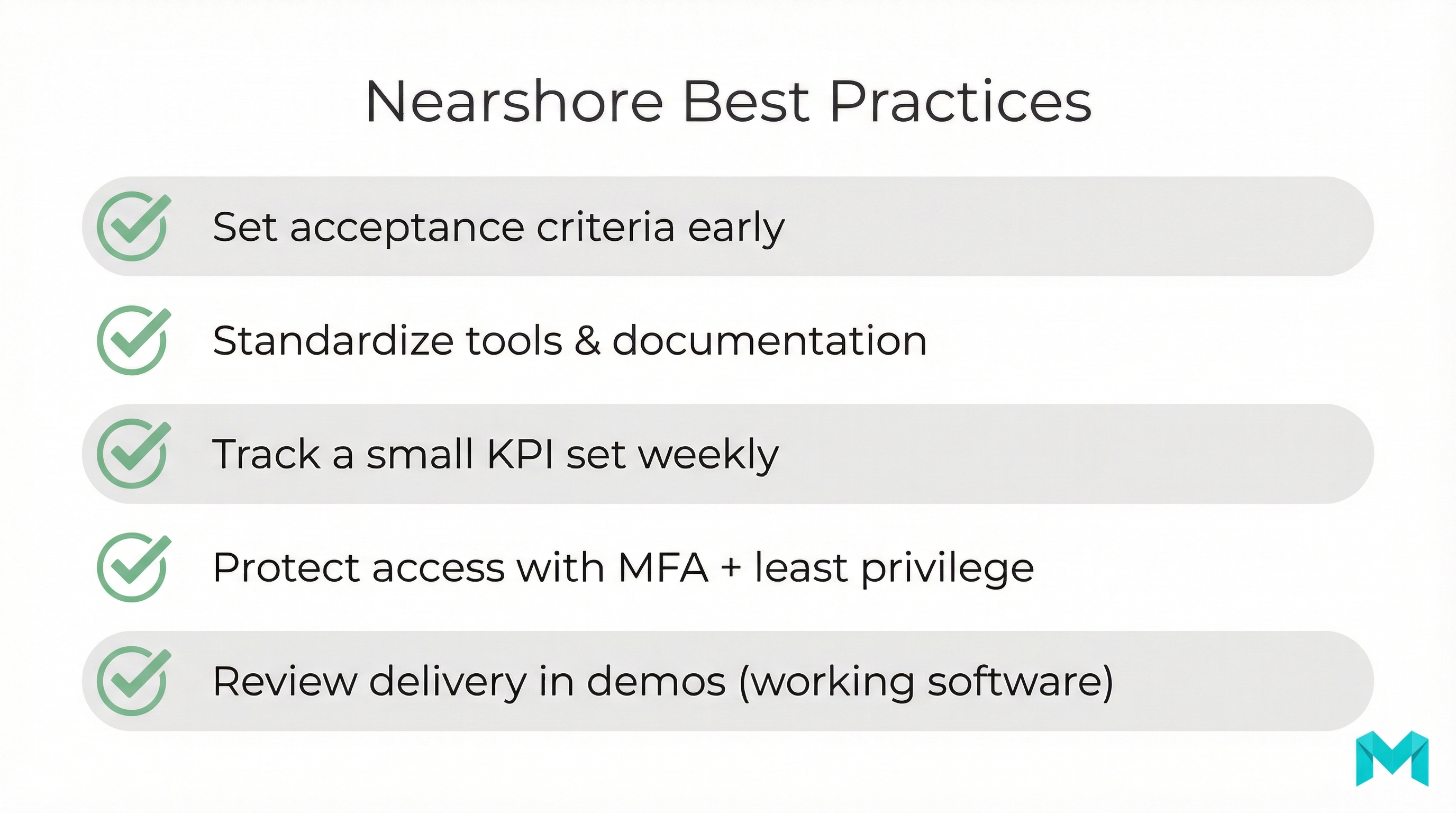
- nearshore-delivery-scorecard-2026.png
- Alt: “Nearshore delivery scorecard 2026 for governance KPIs security and SDLC ownership”
- Prompt: “Checklist infographic with four sections and subtle tech texture; professional consulting look”
How Musketeers Tech Can Help
Musketeers Tech helps teams get the upside of nearshore software development—speed and cost efficiency—without the downside of misalignment and delivery drift. We do this by pairing strong product discovery and architecture standards with disciplined execution (quality gates, CI/CD, and measurable milestones).
Depending on what you need, we can support you through:
- Building or scaling your product team (web and app engineering, QA automation, DevOps foundations)
- MVP delivery with clear scope boundaries and release criteria
- CTO-level guidance for roadmap, hiring strategy, and delivery governance
You can explore relevant services like Web Application Development, MVP Development Services, and CTO as a Service. For examples of execution across AI and product experiences, browse our portfolio (including projects like BidMate and DoctorDost).
Learn more about our Web Application Development or see how we helped clients with similar challenges in our portfolio.
Web Application Development
Modern web apps with scalable architectures, CI/CD, and measurable outcomes.
MVP Development
Ship your MVP in weeks with clear acceptance criteria and rapid iterations.
Frequently Asked Questions (FAQs)
Nearshore software development uses teams in nearby countries with significant time-zone overlap, enabling real-time collaboration. Offshore development typically involves distant regions with large time differences, which can increase async communication and slow feedback loops.
Final Thoughts
Nearshore software development can be a powerful way to ship faster—especially when you need real-time collaboration, strong velocity, and predictable delivery without paying fully onshore rates. The model succeeds when you choose the right engagement structure, define SDLC ownership, and run tight governance with quality gates and measurable KPIs.
If you’re evaluating nearshore software development companies, don’t stop at “nice sales calls†and resumes. Use a scorecard, validate process maturity, and require transparency in cadence, metrics, and security/IP handling. That’s how nearshoring becomes a repeatable growth lever instead of a risky experiment.
Need help with nearshore software development? Check out our Software Strategy Consulting or explore our recent projects.
Related Posts:
- nearshore software development
- software outsourcing
- staff augmentation
- dedicated teams
- latam developers
