





- 04 Feb, 2026
- Application Development
- Software Strategy
- By Musketeers Tech
Best Mobile App Development Platforms in 2026 (Top Picks)
Choosing the best mobile app development platforms in 2026 isn’t just a “Flutter vs. React Native” debate anymore. Teams now have to balance faster delivery, AI-assisted coding, privacy expectations, app store compliance, offline-first requirements, and long-term maintenance costs all while hiring markets keep shifting.
This guide is built for founders, product managers, and business teams who want a clear shortlist (not a 50-tool directory). You’ll get:
- A practical breakdown of today’s top mobile app development platforms
- A comparison table you can use in stakeholder meetings
- A 2026-ready decision framework (including where low-code/no-code fits and where it doesn’t)
If you’re planning an MVP, migrating a legacy app, or building an enterprise-grade product, this article will help you pick a platform that won’t slow you down six months from now.
Get Started Learn More View Portfolio
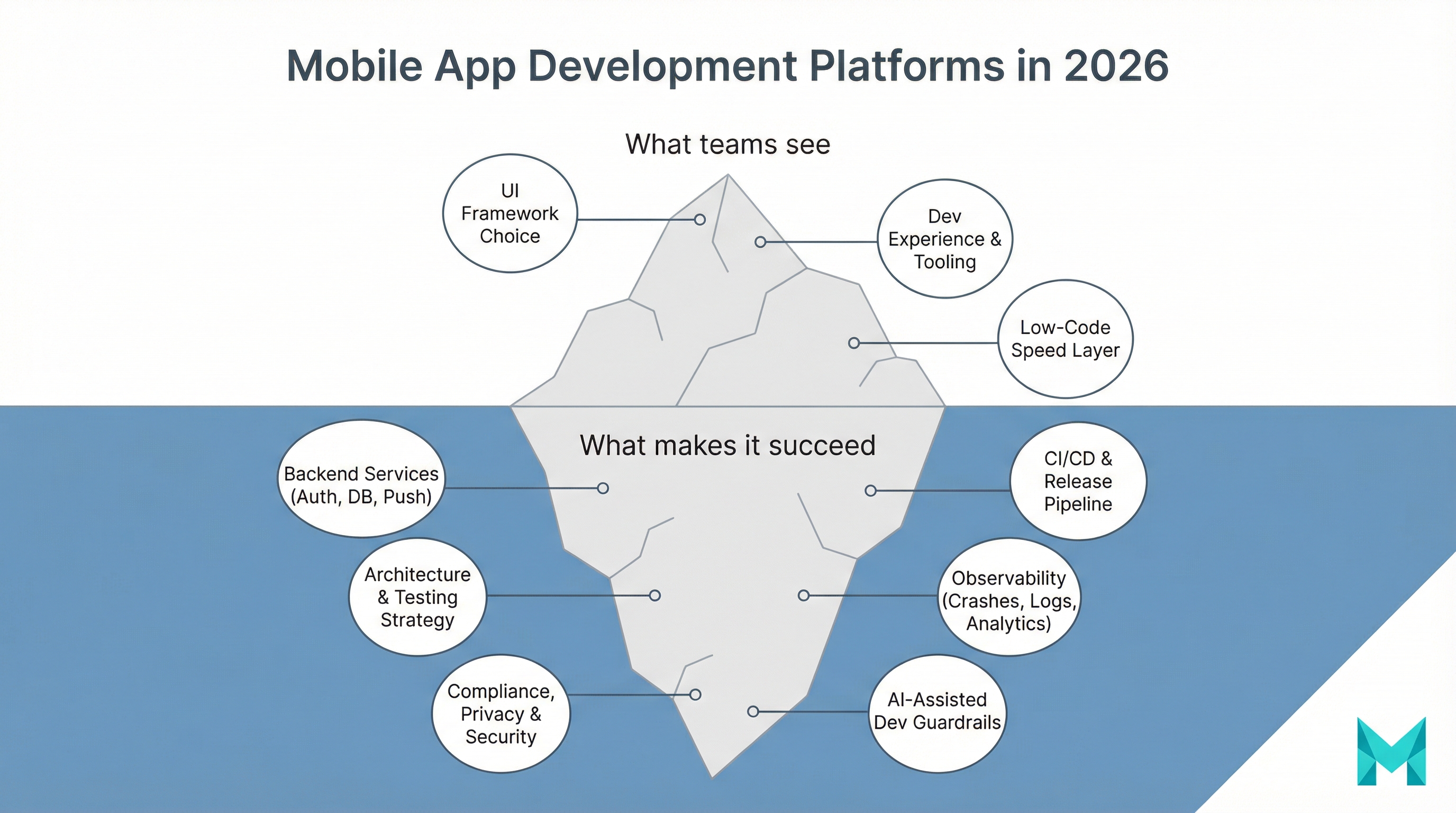
What is a mobile app development platform? (MADP)
A mobile app development platform is a set of tools that helps you design, build, test, ship, and maintain mobile apps—typically covering some combination of:
- UI framework (how you build screens)
- Runtime (how the app executes on iOS/Android)
- Device APIs (camera, location, Bluetooth, biometrics)
- Backend services (auth, databases, push notifications, analytics)
- DevOps and release tooling (CI/CD, signing, store deployments)
In practice, the market splits into three buckets:
-
Native platforms (Swift/SwiftUI for iOS; Kotlin for Android)
Best when you want maximum performance, platform-first UX, or deep OS integrations. -
Cross-platform frameworks (Flutter, React Native, Kotlin Multiplatform, .NET MAUI, Ionic/Capacitor)
Best when you need one product team to ship iOS + Android with shared code. -
Low-code/no-code mobile app development platforms (FlutterFlow, OutSystems, Mendix, Glide/Adalo/Thunkable)
Best for internal tools, prototypes, and workflow apps—when requirements are clear and complexity is moderate.
If you’re also evaluating cross-platform options, see our guide on the best cross-platform app development frameworks.
Why mobile app development platforms matter in 2026
In 2026, the “right” platform is less about hype and more about risk management and time-to-market.
What's different in 2026?
- AI is changing development workflows. You need patterns, testing, and observability so AI speeds you up without creating brittle code.
- Privacy and compliance are table stakes. Platform choice impacts how consistently you enforce them.
- Performance expectations are higher. Smooth UI, fast startup, and reliable offline behavior matter globally.
- Hiring and maintainability drive total cost. Cheap to build can be expensive to operate.
Rule of thumb: optimize for total cost of ownership (TCO) over 18-36 months, not just initial build speed.
Best mobile app development platforms in 2026 (shortlist)
Below is a curated shortlist focused on platforms that are widely used, actively maintained, and realistic for teams that must ship and iterate.
Quick comparison table (frameworks + platforms)
| Platform | Category | Best for | Strengths | Watch-outs |
|---|---|---|---|---|
| Flutter | Cross-platform framework | Consumer apps, polished UI | Fast UI, consistent design, strong ecosystem | App size, some platform-specific work |
| React Native | Cross-platform framework | Teams with web/JS skills | Huge ecosystem, fast iteration | Native module maintenance, version churn |
| Kotlin Multiplatform (KMP) | Cross-platform (shared logic) | Sharing business logic + native UI | Native UX + shared core | Requires strong architecture discipline |
| .NET MAUI | Cross-platform framework | Microsoft/.NET shops | Shared C#, enterprise fit | Ecosystem varies by use case |
| Ionic + Capacitor | Hybrid | App shells, content-driven apps | Web skills, fast delivery | Performance limits for complex UI |
| Firebase | Backend platform | MVPs, realtime features, push | Auth, push, analytics, serverless | Vendor lock-in, cost scaling patterns |
| OutSystems / Mendix | Enterprise low-code | Internal apps, workflow, governance | Speed + governance + integrations | Licensing cost, customization ceilings |
| FlutterFlow | Low-code (Flutter-based) | Fast prototypes to production | Visual dev + Flutter export options | Complex logic still needs engineering |
| Glide / Adalo / Thunkable | No-code | Simple apps, internal tools | Extremely fast to launch | Limits for custom UX + scale |
For official references on two of the most common building blocks:
- Flutter: https://flutter.dev/
- Firebase: https://firebase.google.com/
- Flutter: Design-system-friendly, great performance, strong tooling.
- React Native: Huge ecosystem, fast iteration, JS/TS skills reuse.
- KMP: Share core logic while keeping fully native UI.
- .NET MAUI: Best for .NET-first organizations.
- Ionic/Capacitor: Web-first speed for content-heavy apps.
Cross-platform frameworks (when you want one team for iOS + Android)
Flutter
Best for: product-led apps where UI polish and consistency matter.
Why teams pick it:
- Strong UI performance and consistent rendering
- Great for design-system-driven products
- Mature ecosystem and tooling
Trade-offs to plan for:
- Some features still require native integrations
- Larger binaries compared to some alternatives
React Native
Best for: teams already strong in JavaScript/TypeScript and shipping quickly.
Why it’s still a top choice:
- Large talent pool
- Rich third-party ecosystem
- Fast iteration with hot reload
Trade-offs:
- Dependency churn and native bridge maintenance can grow over time
- “Works on my phone problems if CI and device testing aren’t disciplined
Kotlin Multiplatform (KMP)
Best for: enterprise or scaling teams that want shared core logic but fully native UI.
KMP is often a strategic choice when:
- iOS and Android UX must feel native
- You can invest in clean architecture (shared domain/data layers)
- You want long-term maintainability over quick wins
Good primer from Kotlin: https://kotlinlang.org/docs/multiplatform/cross-platform-frameworks.html
.NET MAUI
Best for: organizations standardized on Microsoft tooling and C#.
Strengths:
- Strong fit for enterprise dev teams
- Shared codebase in C#
Trade-offs:
- Some app categories may require extra platform-specific work (plan for it upfront)
Ionic + Capacitor
Best for: simpler apps where web content dominates and speed matters.
Strengths:
- Leverages web teams
- Fast for dashboards and content-heavy experiences
Trade-offs:
- Complex animations and highly interactive UI can be harder to keep “native-feelingâ€
Backend & app services (often the hidden “platform†that matters)
Many mobile apps fail not because the UI framework was wrong—but because backend, data sync, and observability were under-designed.
- Authentication: SSO, MFA, and passkeys support
- Push notifications and messaging reliability
- Offline-first sync with conflict resolution
- Analytics + crash reporting from day one
- Data governance: PII handling, retention, and auditing
Firebase remains a common choice for MVPs because it bundles auth, push, analytics, and serverless building blocks. But for regulated or enterprise products, you may need a more explicit architecture (custom backend, private cloud, or stronger governance).
Watch vendor lock-in. Model your 12–24 month data egress and migration path before committing to proprietary backends.
Low-code / no-code mobile app development platforms (when speed is the product)
Low-code/no-code is legitimate in 2026—when used for the right use case.
- Use it when: requirements are clear and mostly CRUD/workflow, you need to validate quickly, internal stakeholders want rapid iterations, and the app integrates with SaaS/APIs.
Avoid low-code/no-code when
- You need deep hardware integrations or complex offline behavior
- Custom UI/UX at scale is a core differentiator
- Performance is a top advantage in your market
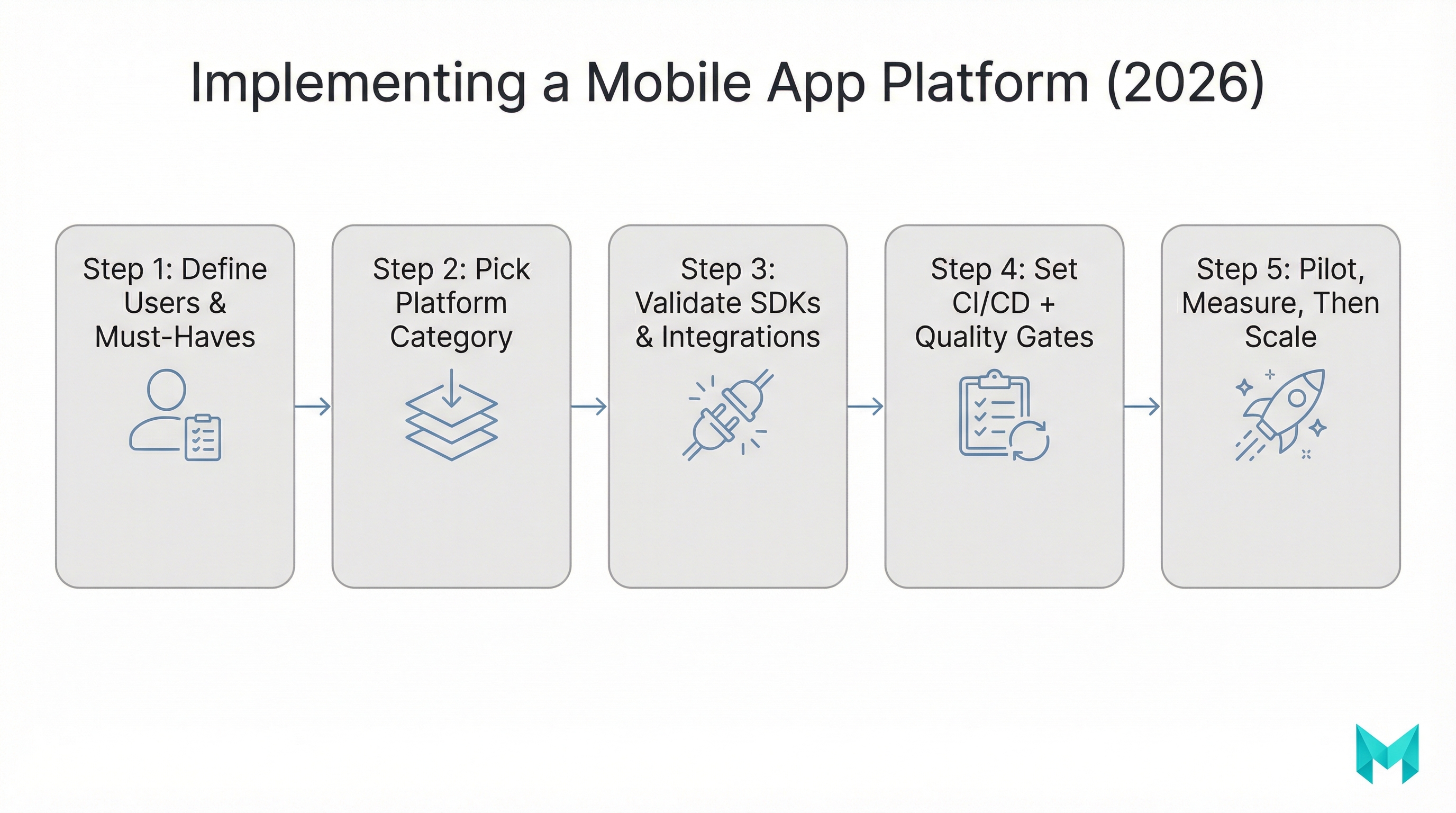
How to choose the right platform (8 criteria that actually decide outcomes)
Competitors often say pick what your team knows. That’s true but incomplete. Use these criteria to avoid expensive rewrites:
- User experience requirements: if “native feel” is non-negotiable, consider native or KMP with native UI.
- Performance profile: graphics-heavy or real-time apps need stricter platform choices.
- Offline-first needs: architecture and backend strategy must support it (not just a checkbox).
- Time-to-market vs. longevity: plan the path to scale (modular code, tests, CI, monitoring).
- Hiring and skills availability: hiring can become a hidden cost multiplier.
- Security & compliance: encryption, secure auth, audit trails, and data boundaries.
- Integration complexity: payments, maps, device features, and third‑party SDKs.
- Total cost of ownership (TCO): dev time, QA, CI/CD, store overhead, tooling, upgrades.
If you’re building an MVP and need a clear scope-to-stack plan, our MVP development services team can help you choose the right approach before you commit engineering time.
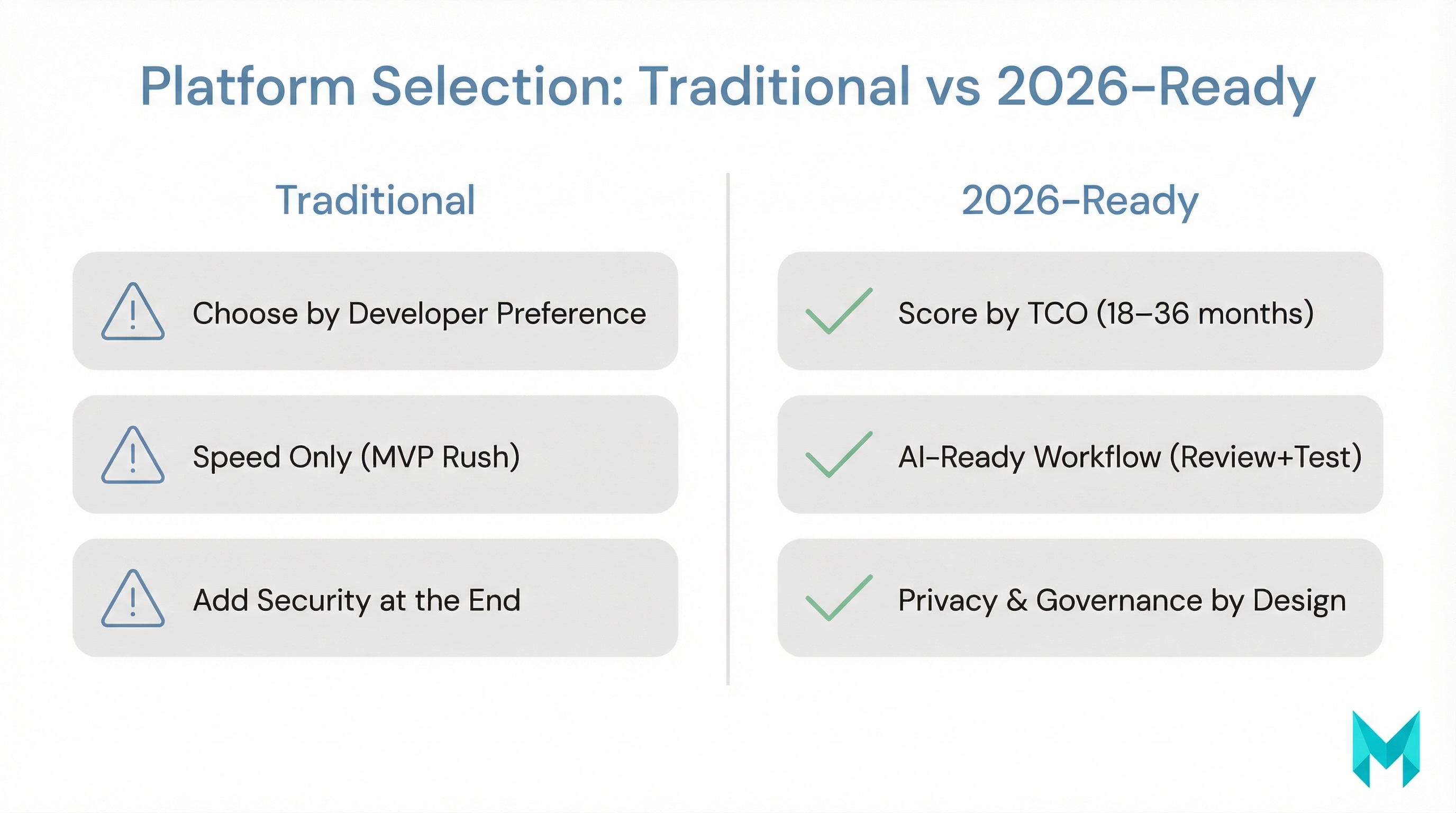
The 2026 decision matrix (our practical framework)
Here’s a lightweight scoring approach (1–5) you can use with stakeholders. Score each option across the factors below, then choose the highest total that also meets your must-haves.
- Speed to first release
- Long-term maintainability
- Native UX requirements
- Offline-first complexity
- Security/compliance needs
- Integration risk
- Team skills/hiring
- Cost predictability
A 2026-specific twist: AI-assisted development readiness
In 2026, AI tools can boost velocity but only if your platform supports:
- Strong typing and clear architecture boundaries
- Automated testing (unit + integration)
- Predictable build and release pipelines
- Observability (logs, traces, crashes)
If your workflow is “prompt or paste or ship,” AI increases risk. If your workflow is “prompt or review or test or deploy,” AI increases speed safely.
Recommended picks by scenario (fast heuristic)
- Startup MVP (tight timeline, small team): Flutter or React Native + Firebase (with a plan to control costs)
- Enterprise (governance, integrations, compliance): KMP (shared core) or .NET MAUI + structured backend + CI controls
- Internal workflow apps: OutSystems/Mendix or a low-code tool, with integration and security review
- Content-first app: Ionic/Capacitor may be enough if performance requirements are moderate
For app store compliance, keep an eye on Apple’s guidelines as early as design and data collection decisions: https://developer.apple.com/app-store/review/guidelines/
Use cases: which platform fits your project?
1) B2C app where UI is the differentiator
Pick Flutter or native if motion design, fast UI, and consistent branding are key.
2) B2B app with many integrations (CRM, ERP, analytics, auth)
Pick a platform that won’t fight your enterprise constraints:
- KMP + native UI if UX must be native
- .NET MAUI if your org is standardized on Microsoft
- Strong backend architecture matters more than UI choice here
3) Marketplace or on-demand app (payments, maps, notifications)
Pick the platform based on:
- SDK compatibility (payments, maps)
- Push and background task reliability
- Monitoring/crash reporting maturity
4) Internal tooling and operations apps
Use low-code/no-code when the app is workflow-heavy and time-to-value matters most—but set clear boundaries for:
- Data governance
- Role-based access control
- Integration reliability
Best practices & common mistakes (what teams regret later)
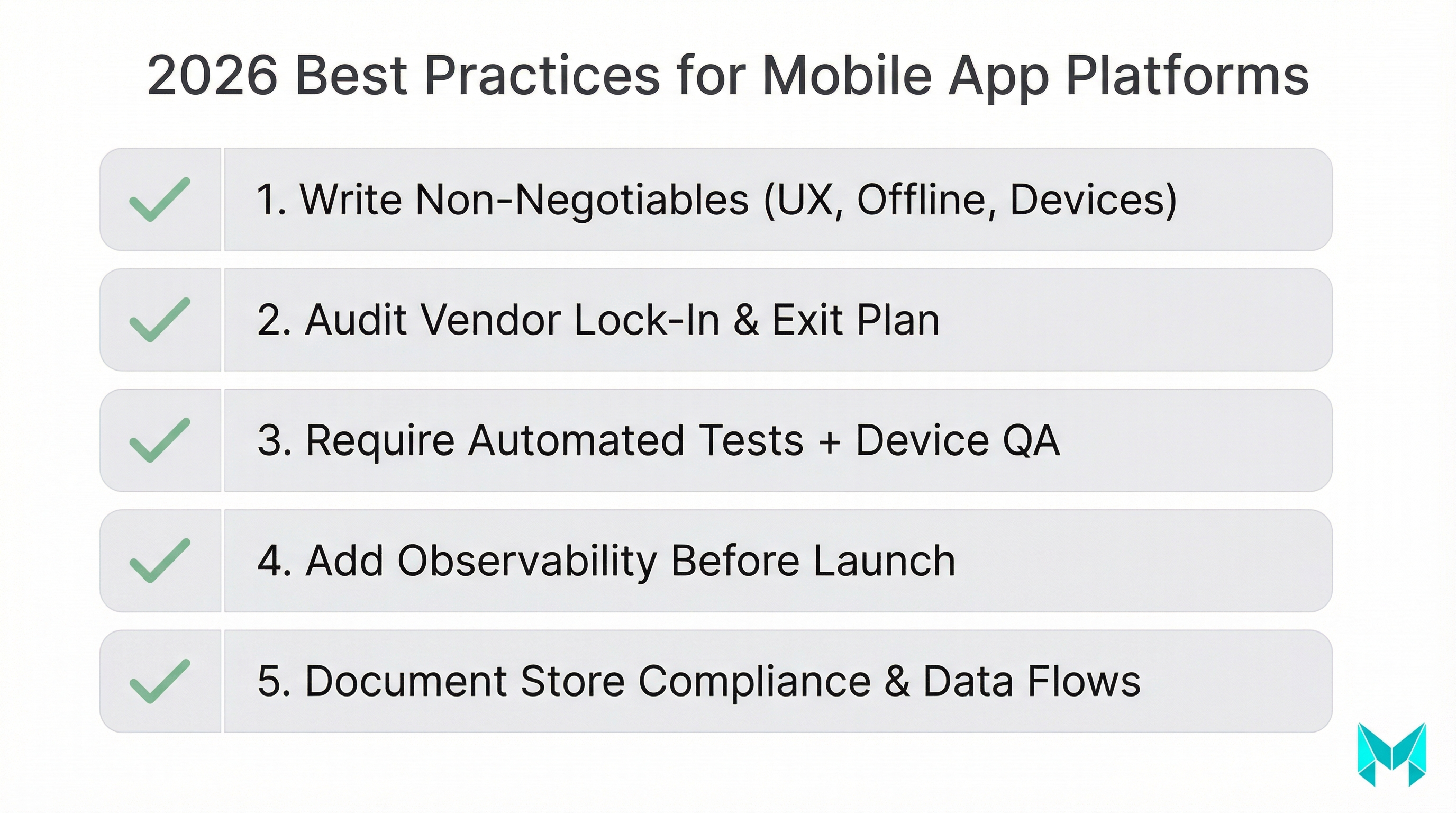
Best practices
- Define “native feel†early. If stakeholders expect iOS/Android-first UX, pick a platform that can deliver without hacks.
- Invest in CI/CD from day one. Automate builds, tests, signing, and store releases.
- Create an integration plan. List required device features and third-party SDKs before choosing.
- Design for analytics + crashes. You can’t fix what you can’t observe.
- Plan backend + data model with offline in mind. Offline sync is where timelines slip.
Common mistakes
- Choosing low-code for a product that needs deep customization
- Underestimating QA across devices and OS versions
- Not budgeting time for store review requirements and policy changes
- Letting architecture drift (especially when AI tools increase code output)
Tools & resources to ship faster (platform-agnostic)
No matter which platform you pick, most successful teams standardize a toolkit around:
- Design system + component library (consistency and speed)
- Automated testing (unit + integration + device testing)
- Monitoring and crash reporting (so you can iterate safely)
- Release management (feature flags, staged rollouts)
- Secure secrets and configuration (no keys in repos)
If you’re building a custom product (not just an internal tool), consider pairing your platform choice with a scalable delivery plan via our bespoke application development offerings.
Frequently Asked Questions (FAQs)
The best platform depends on your constraints. For many teams in 2026, Flutter or React Native is best for cross-platform speed, while native or Kotlin Multiplatform is best when you need the most native UX and performance.
How Musketeers Tech Can Help
Musketeers Tech helps teams choose and successfully deliver on the right mobile app stack without costly rewrites. We typically start by mapping your product requirements (UX expectations, offline needs, integrations, security constraints, timeline, budget) to a platform strategy, then build a delivery plan that includes architecture, CI/CD, and release readiness.
If you’re launching fast, we can support discovery, prototyping, and build execution through our MVP Development Services. For teams building a differentiated product or scaling beyond MVP, our Bespoke Applications Services approach focuses on maintainability, performance, and long-term TCO.
We also bring applied AI experience from products like BidMate (AI assistant) and conversational experiences like Chottay (AI order taking)useful when your mobile roadmap includes automation, personalization, or support workflows.
Learn more about our Primary Service Name or see how we helped clients with similar challenges in our portfolio.
Bespoke Applications
Custom mobile products built for performance, compliance, and TCO.
Software Strategy
Architecture, platform selection, and delivery playbooks for 2026.
Final Thoughts
The best mobile app development platforms in 2026 are the ones that fit your product reality: your users expectations, your integration landscape, your compliance obligations, and your teams ability to ship reliably month after month. For many organizations, the winning move is not chasing a single best tool, but choosing a platform family (UI framework + backend services + delivery tooling) that keeps TCO predictable.
If you’re early-stage, prioritize speed and learning then plan the path to scale. If you’re enterprise or regulated, prioritize governance, testing, and architecture boundaries so you can evolve safely. And if low-code/no-code is on the table, use it strategically for the right workflows while protecting core product differentiation.
Need help with mobile app platform selection or delivery? Check out our MVP development services or explore our recent projects.
Related Posts:
