





How AI Agents Are Revolutionizing Customer Support in 2026
By 2026, 80% of customer service inquiries will be handled by AI agents without human intervention. If your support team is still manually triaging tickets, drafting responses, or playing phone tag with frustrated customers, you’re burning budget on problems that autonomous systems can solve better, faster, and cheaper. AI agents for customer support aren’t coming—they’re here. This guide shows you exactly what’s changed, why it matters, and how to deploy agents that actually reduce support costs while improving customer satisfaction.
The shift isn’t just incremental. Over the past 18 months, the capabilities of AI agents have evolved from simple chatbots that answer FAQ questions to autonomous systems that can triage complex issues, authenticate customers, resolve problems across multiple systems, and escalate edge cases—all without human intervention. Companies deploying AI agent customer support today report 40-60% reduction in tickets reaching human agents, resolution time cuts of up to 80%, and support team capacity that can finally focus on high-value, relationship-building interactions instead of busywork.
What Changed: From Chatbots to Autonomous Agents
The customer support AI of 2023 was narrow: answer a pre-defined question or trigger a rule-based workflow. If the query fell outside the training data or decision tree, the system had one move—escalate to a human.
Modern AI agents in customer support work differently. They:
- Understand context across your entire customer ecosystem — access order history, billing info, product usage, and previous interactions without prompting
- Take autonomous action — process refunds, upgrade subscriptions, reset passwords, or create follow-up tasks without waiting for approval
- Route intelligently — classify tickets by complexity and urgency, escalate predictively (before the customer asks), and route to the right specialist with full context already attached
- Learn from interactions — improve response quality and reduce hallucinations through continuous feedback loops tied to resolution metrics
- Handle multi-turn conversations — maintain state across 10+ turns, ask clarifying questions, and resolve issues that would have previously required 3-4 human escalations
The State of AI Customer Support in 2026
Gartner reports that companies with AI agent customer support in production see an average 44% reduction in support costs, 30% improvement in customer satisfaction scores, and 2x faster issue resolution times. Early adopters are already seeing these gains; laggards will feel the competitive pressure within 12 months.
How AI Agents Work in Customer Support
An AI agent in customer support operates as a decision-making loop: perceive → reason → act → observe → repeat.
Here’s the actual flow when a customer submits a support request:
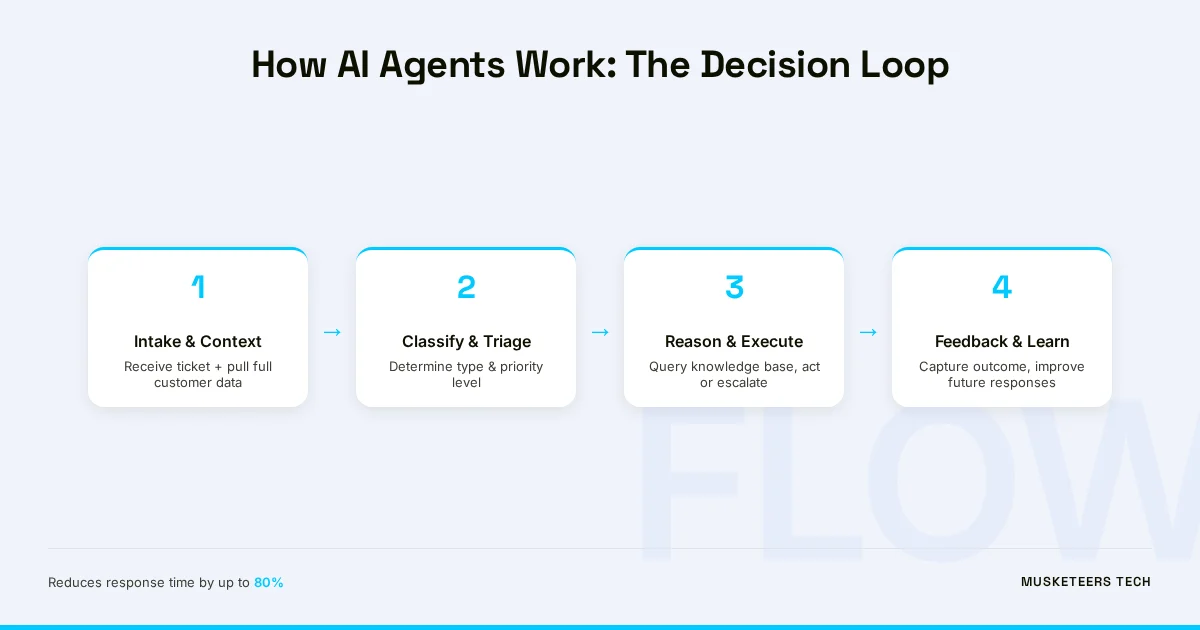
1. Intake & Context Assembly
The agent receives the customer’s message and immediately pulls their full context: account status, recent interactions, open tickets, known issues, and product configuration. This single step eliminates the need for customers to re-explain their problem.
2. Intent Classification & Triage
The agent classifies the issue (billing, technical, feature request, complaint) and assigns a priority level based on business rules and customer value. Low-priority feature requests might go straight to a backlog; high-priority outages trigger escalation protocols immediately.
3. Knowledge Retrieval & Reasoning
The agent queries your internal knowledge base (documentation, FAQs, past solutions) and structured data (API lookups, database queries). Using retrieval-augmented generation (RAG), it synthesizes information that’s both relevant and current, avoiding hallucinations that plague generic LLMs.
4. Action Execution
If the agent has permission and the issue is routine, it acts directly: process a refund, send a reset link, update a subscription, or create a task in your backend systems. The customer gets resolution in seconds, not days.
5. Human Escalation (If Needed)
For novel, sensitive, or high-value cases, the agent escalates with a full summary of context, attempts made, and recommended next steps. Your human team jumps in at the 20% of issues that truly need judgment.
6. Feedback & Continuous Improvement
Every interaction (whether the agent resolved it or escalated) is tagged with an outcome: resolved on first contact, escalated and resolved by human, customer followed up anyway, negative feedback. This data feeds back into training and prompting strategies to improve future interactions.
- Instant resolution without human intervention — Reduces operational cost per ticket by 60-85% compared to traditional support
- 24/7 availability in multiple languages — Cover global customer base without staffing night shifts or international teams
- Consistent, high-quality responses — No more tone inconsistency, missed context, or burnout-related errors that plague human-only teams
- Reduced average handle time (AHT) — Customers get answers in seconds vs. minutes of phone hold time
- Proactive issue detection — Agents flag patterns in incoming tickets and alert product/ops teams before issues escalate
Customer Support AI Architecture: What You Actually Need to Build
Before you deploy, you need to answer a critical question: What infrastructure does an AI customer support agent actually require?
The good news: you don’t need to build from scratch. But you do need to understand the stack. A production AI agent for customer support typically includes:
| Component | Purpose | Example Tools |
|---|---|---|
| LLM Engine | Core reasoning & response generation | GPT-4, Claude 3, Llama 2 |
| Knowledge Base (RAG) | Ground agent responses in your data | Pinecone, Weaviate, ChromaDB |
| Tool Integration Layer | Connect agent to CRM, billing, auth systems | LangChain, CrewAI, AutoGen |
| Memory & Context Store | Maintain conversation history, customer state | Redis, vector databases |
| Evaluation & Feedback | Measure quality, detect failures, trigger retraining | Custom dashboards, GPT-as-judge |
| Safety & Guardrails | Prevent prompt injection, enforce auth, limit scope | prompt templates, role-based access |
| Orchestration & Scaling | Route requests, manage queues, monitor uptime | Kubernetes, AWS, custom APIs |
The complexity comes not from the LLM itself—that’s commoditized—but from safe, reliable tool use. Your agent needs permission-checked access to systems like Stripe, Salesforce, or your billing database. One bug in the tool integration could expose customer data or execute unintended refunds. This is why governance, observability, and testing are non-negotiable in production AI customer support systems.
Common Architecture Mistakes
Teams often treat the LLM as the core and tool integration as an afterthought. In reality, the tools are 70% of the complexity. Invest in robust API design, auth/permission systems, and failure handling. A mediocre LLM with bulletproof tools beats a smart LLM with sloppy integrations.
Implementation Roadmap: 30/60/90 Days to Deployment
If you’re ready to implement AI agent customer support, here’s a realistic phased approach. This assumes you have a dedicated engineering team or are partnering with a vendor/consultancy.
Phase 1: Foundation (Days 1-30)
Goal: Build the core loop with a narrow scope
- Define scope — Pick 1-2 high-volume, routine issues to automate (e.g., password resets, order status, billing FAQ)
- Assemble knowledge base — Audit existing documentation, FAQs, and past tickets; structure into a RAG-ready format
- Set up integrations — Connect agent to your CRM, ticketing system, and 2-3 critical backend APIs (read-only first)
- Establish metrics — Define “success”: resolution rate, customer satisfaction, escalation rate, cost per ticket
- Build evaluation framework — Create a small test set of tickets; grade agent responses on accuracy, tone, and safety
Deliverables: Functional proof-of-concept agent, knowledge base v1, integration architecture, evaluation dashboard
Phase 2: Expansion & Safety (Days 31-60)
Goal: Expand to 5+ issue types; add guardrails and human oversight
- Expand knowledge base — Add more FAQ topics, product guides, troubleshooting workflows
- Enable write operations — Add permission-gated actions (refund initiated, but requires human approval; password reset auto-executed with rate limiting)
- Implement monitoring & alerting — Track agent confidence, hallucination rate, tool call errors, customer escalation feedback in real-time
- Build a human review queue — Create a dashboard where support leads can spot-check agent responses, provide feedback, and flag patterns
- Test failure modes — Intentionally send adversarial prompts, out-of-scope questions, and edge cases; measure graceful degradation
- Run 100+ representative tickets — Grade agent performance; identify common failure patterns
Deliverables: Expanded agent (5+ issue types), monitoring dashboard, human review system, failure mode report
Phase 3: Production & Optimization (Days 61-90)
Goal: Launch to 10-30% of incoming traffic; iterate based on real-world feedback
- A/B test — Route 20-30% of incoming support requests to the agent; measure impact on resolution rate, satisfaction, escalation, and cost
- Optimize prompting — Use failures from the human review queue to refine system prompts, tone, and decision logic
- Expand integrations — Add remaining backend systems (loyalty, inventory, shipping, etc.)
- Automate escalation — Route complex/sensitive cases to humans with full context; track accuracy of agent triage
- Plan scaling — Based on success metrics, decide whether to expand to 50-80% of traffic or additional support channels (chat, email, voice)
Deliverables: Live agent handling 20-30% of support volume, optimization report, plan for Phase 4 (scaling to 80%+ automation)
Why AI Customer Support Agents Fail (And How to Avoid It)
Most AI agent customer support deployments stumble for the same reasons. Here’s the hit list:
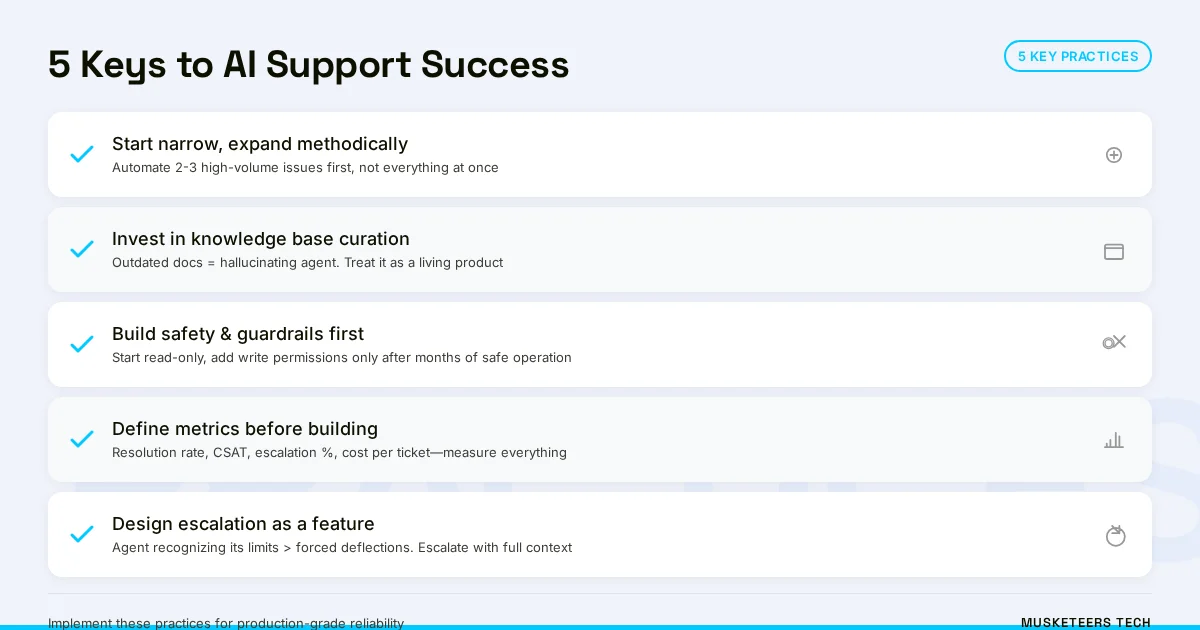
The Problem: Teams try to automate 50 different issue types at once. The agent becomes overloaded, loses accuracy, and escalates more than it solves.
The Fix: Start with 2-3 high-volume, routine issues (password resets, order status, FAQ). Expand only after you’ve proven reliable automation on those. Better to resolve 80% of a narrow category than 20% of everything.
Building vs. Buying: AI Customer Support Platforms
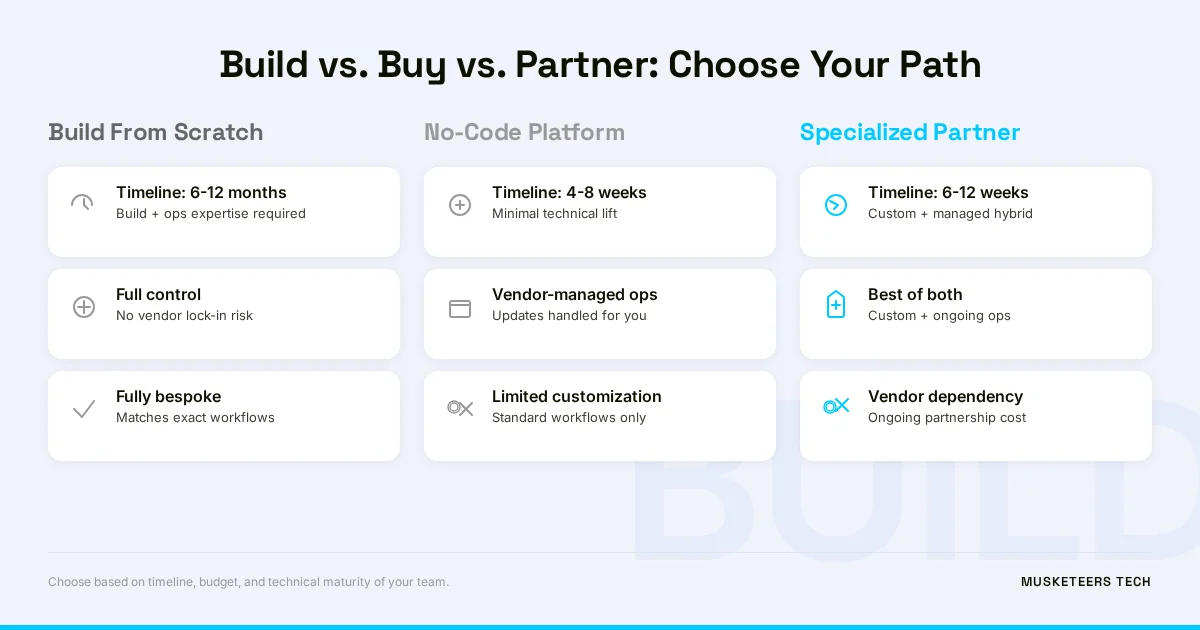
You have three options: build from scratch, use a no-code/low-code platform, or partner with a specialized vendor.
Build from Scratch
- Pros: Full control, customized to your exact workflows, no vendor lock-in
- Cons: 6-12 months to production, requires in-house expertise (LLM ops, prompt engineering, infrastructure)
- Best for: Large enterprises with mature technical teams, highly bespoke requirements
No-Code Platforms (Intercom AI, Drift, Zendesk)
- Pros: Deploy in weeks, minimal technical lift, vendor manages ops
- Cons: Limited customization, vendor-dependent model quality, higher ongoing costs
- Best for: Mid-market teams, standard support workflows, limited engineering capacity
Specialized AI Agent Vendors (or agency partners like Musketeers Tech)
- Pros: Best of both worlds—custom AI agents tailored to your workflow, managed infrastructure, faster than build
- Cons: Vendor dependency, ongoing partnership costs
- Best for: Companies that want production AI agent support but don’t have the in-house team to build + maintain
The decision depends on your timeline, budget, and technical maturity. A fast-moving startup might pick a no-code platform to validate the concept in 8 weeks. A Fortune 500 with $10M customer support budget might invest in a hybrid approach: use a specialized platform as the foundation but customize heavily with in-house teams.
Frequently Asked Questions
Not fully, but they’ll transform the role. Human agents will focus on high-complexity issues, relationship-building, escalations, and edge cases instead of routine ticket triage. A team of 20 humans + AI agents can do the work of 80 humans handling tickets manually. Your support team gets smaller, but their job becomes more skilled and satisfying.
How Musketeers Tech Can Help
AI agents for customer support represent one of the highest-ROI investments a company can make today. But deploying them requires expertise across LLMs, tool integration, governance, and production operations. Most teams either underestimate the complexity and launch agents that fail in production, or overengineer and spend 18 months building what a 12-week agency engagement could deliver.
At Musketeers Tech, we specialize in custom AI agent development that’s tailored to your specific customer support workflows. We handle the full pipeline: knowledge base assembly, model selection, safety design, integration with your CRM/ticketing system, and ongoing optimization. We’ve deployed customer support agents across SaaS, fintech, e-commerce, and enterprise software—and we know exactly where teams typically stumble.
Beyond AI agents, our generative AI application services help teams build the broader infrastructure needed for safe, scalable AI systems. And if your AI initiative requires broader organizational change—process redesign, team restructuring, or technology strategy—our software strategy consulting team can help you plan the journey.
We also recommend reviewing our deep-dive on how to build your own AI agent if you’re curious about the technical details, and exploring our portfolio of recent AI automation projects to see how other teams have deployed similar systems.
AI Agent Development
Custom AI agents that automate customer support, reduce costs by up to 60%, and deliver 24/7 availability. We handle architecture, safety, and scaling.
Generative AI Application Services
Build enterprise-grade AI applications that create value beyond chatbots—from content generation to decision automation with full security controls.
Conclusion: AI Agents Aren’t the Future of Customer Support—They’re the Present
By 2026, companies that haven’t deployed AI agents for customer support will be at a structural disadvantage. Their support teams will be stretched thin, customers will expect faster response times, and competitors will have already built the AI advantage. The cost of waiting another 18 months is real: lost market share, burnt-out support staff, and a technical debt of complexity that’s harder to pay down later.
The path forward is clear: start narrow, measure everything, expand methodically, and partner with teams that understand both the technology and the business. AI agents for customer support can reduce your support cost by 40-60%, improve customer satisfaction, and free your team to focus on relationships instead of tickets.
If you’re ready to explore what AI agent customer support could mean for your business—whether through a deep technical partnership or a strategic consulting engagement—reach out to Musketeers Tech. We’ve helped companies at every stage of the AI journey, from first proof-of-concept to managing agents that handle millions of interactions annually.
The question isn’t whether AI will transform customer support. It’s whether your company will lead that transformation or follow it. The choice, and the timeline, are yours.
Last updated: 28 Feb, 2026
